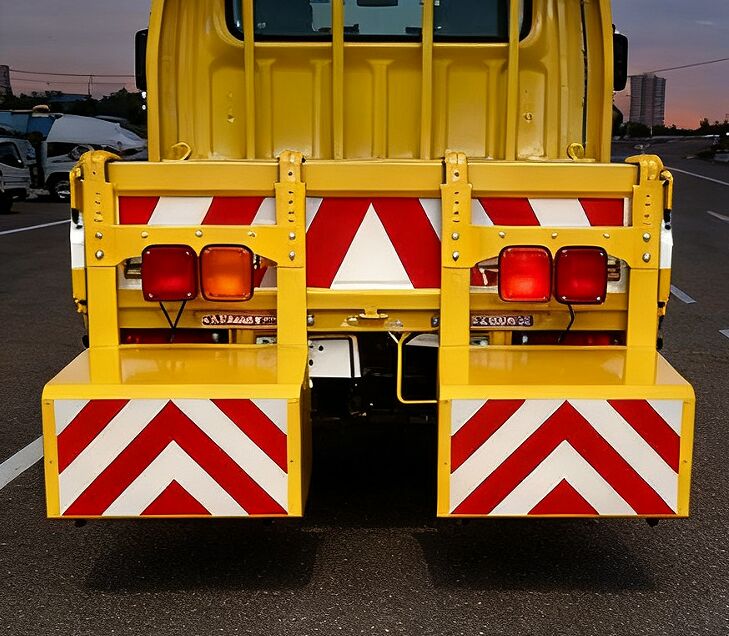
The Truck Mounted Attenuator Removable system functions as an anti-collision absorbing pad installed at the rear of vehicles. When rear-end collisions occur, its unique internal energy absorption structure reduces the massive impact force, protecting personnel safety and minimizing vehicle damage. Customization options are available to meet specific customer requirements.
Constructed from welded metal with traffic yellow as the primary color, this device features external electrostatic spraying and built-in special aluminum profiles. Lightweight and easy to carry and install, it offers flexible deployment according to actual needs. Optional flash lamps provide strong light emission during nighttime or poor weather conditions, ensuring highly visible warning effects.
This product is specifically designed for municipal and sanitation mobile work vehicles, suitable for road sweeping, watering, landscaping maintenance, and similar tasks. When suspended at the rear of the vehicle, it forms a physical buffer barrier to reduce the risk of rear-end collisions and underride accidents, ensuring the safety of both workers and road users.
What is a Truck Mounted Attenuator (TMA) and what is its core function?
It is a safety device installed on the rear of trucks, mainly used in road construction, emergency rescue and other scenarios. Its core function is to absorb and disperse the impact force when a vehicle collides accidentally, reducing the damage to the driver, construction personnel and equipment.
Why is Traffic Yellow used as the standard color of TMA?
Traffic yellow has high visibility in various light conditions (daylight, night, rainy and foggy days), which can quickly attract the attention of passing drivers, warn them to slow down and avoid in advance, and reduce the probability of collision accidents.
What is the significance of the "rustproof" performance of TMA?
TMA is usually used in outdoor harsh environments (wind, rain, sun exposure). The anti-rust process (such as galvanizing, plastic spraying) can prevent the metal structure from corroding, extend the service life of the equipment, reduce the frequency of maintenance and replacement, and save the use cost for users.
How does "strict quality control" ensure the performance of TMA?
Quality control covers the whole process from raw material procurement (selecting high-strength steel), production process monitoring (precision welding, anti-rust treatment) to finished product testing (simulated collision test). Each link is strictly checked to avoid unqualified products leaving the factory and ensure the stability of the buffer performance of each TMA.
In what scenarios is TMA most commonly used?
It is widely used in highway maintenance and construction sections, tunnel entrance and exit construction, emergency accident handling sites, road temporary diversion areas and other scenarios that need to protect the safety of construction personnel and equipment.
Does TMA need to be replaced after a collision?
It depends on the severity of the collision. If it is a minor collision and the internal buffer structure is not damaged, it can be reused after inspection and maintenance; if it is a major collision and the buffer components are deformed or invalid, it must be replaced in time to avoid losing the protective effect.


 Your message must be between 20-3,000 characters!