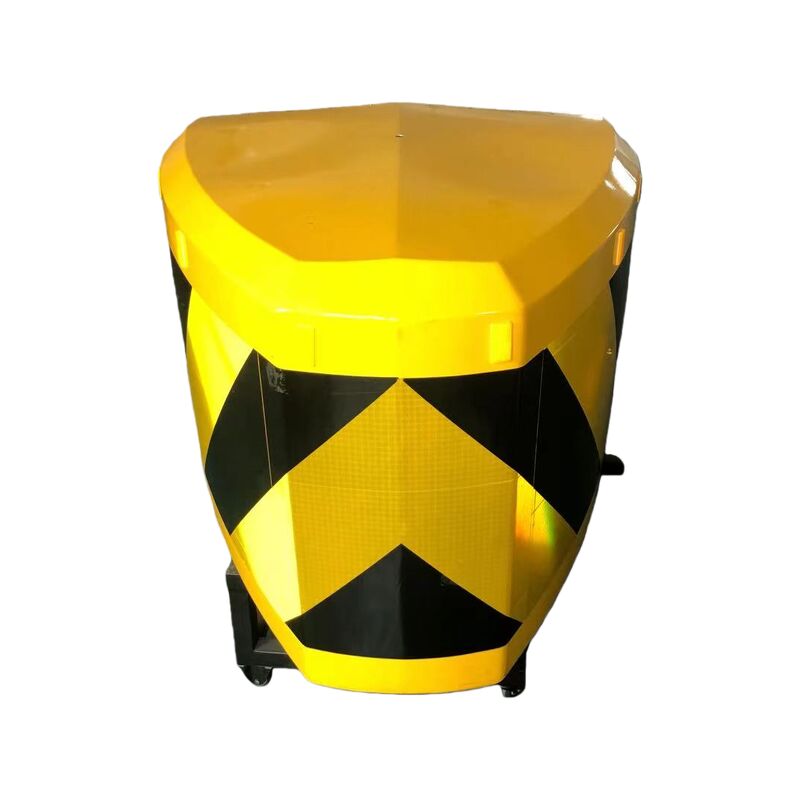
Anti Impact Rustroof Highway Crash Attenuator
This fully re-directive crash cushion is designed for demanding highway applications where maximum impact protection is required. The system is ideal for protecting roadway hazards including rigid barrier ends, tollbooths, utility poles, and other critical infrastructure locations.
Engineered for narrow median and roadside applications where impact trajectories are primarily from the front, this represents the most effective and cost-efficient crash cushion system available.

Product Specifications (Model: HSK-100)
| Item |
Specification Parameters |
| Model |
HSK-100 (Other models: HSK-80, HSK-60, etc.) |
| Protection Level |
Designed Protection Speed: 100 km/h |
| Overall Dimensions (L × W × H) |
Above Ground: Approx. 1577mm × 1012mm × 880mm |
| Below Ground Part |
Length: Approx. 2800mm (including foundation), Height: 344mm |
| Foundation Requirements |
Size: Approx. 1700mm × 3500mm
Depth: 650mm
Concrete Weight: Approx. 380kg |
| Main Material |
Energy Absorption Part: High-Strength Aluminum Alloy Profile
Shell/Structure: High-Quality Steel or Aluminum Alloy (Electrostatic Spray Coating) |
| Surface Treatment |
Yellow/Orange Electrostatic Spray Coating + High-Intensity Reflective Film |
| Installation Methods |
1. Embedded (Pre-buried Foundation)
2. Guardrail-Fixed
3. High-Barrier-Fixed |
| Maintenance Feature |
Modular Design; Core energy-absorbing element can be replaced quickly and independently |
| Customization Options |
Dimensions, Color, Reflective Film Grade, etc. (According to customer requirements) |
The product has passed comprehensive crash testing at speeds of 100km/h, 80km/h, and 60km/h. The following data was obtained using a Toyota vehicle at 60km/h impact speed.
*The above chart displays vehicle accelerometer data, where the red line indicates potential fatal injury levels, the brown line indicates severe injury, and the light brown line indicates minor injury.
Comparison: HSK Series vs. Ordinary Steel Guardrails / Crash Barrels
| Aspect |
This Product (HSK Series) |
Ordinary Steel Guardrails / Crash Barrels |
| Protection Level |
✅ Graded energy absorption design (60/80/100 km/h) - optimized for high-speed collisions |
❌ Limited protection capacity; may fail or be penetrated in high-speed impacts |
| Repair Efficiency |
✅ Modular design - damaged core components can be quickly replaced to restore protective function |
❌ Entire section often needs replacement after deformation, resulting in long repair cycles |
| Long-term Cost |
✅ "Repairable" design - lower overall lifecycle costs due to replaceable components |
❌ Generally single-use; requires full replacement after repeated impacts |
| Safety Enhancement |
✅ Patented energy-absorbing structure - certified through crash tests, ensuring high reliability |
❌ Most lack systematic crash testing, with unstable performance |
| Environmental Adaptability |
✅ Electrostatic spray coating resists corrosion; reflective film remains highly visible over time |
❌ Prone to rust (steel) or aging (plastic barrels), requiring frequent maintenance |
Frequently Asked Questions
What is this product?
A specialized crash cushion device for highways, installed at hazardous locations like forks and tunnel entrances. It absorbs collision energy through deformation to protect people and vehicles.
What should be done if it is damaged in a collision?
Simply replace the internal, removable energy-absorbing core module. The outer shell is usually reusable, making repairs fast and cost-effective.
What is the difference between models HSK-60, HSK-80, and HSK-100?
The numbers indicate the protection level, corresponding to different vehicle speeds (in km/h). For example, HSK-60 is suitable for roads with a 60 km/h speed limit.
How many installation methods are available?
Three: embedded in the ground, fixed to guardrails, or fixed to high barriers. The method can be chosen based on site conditions.
Why is it yellow with reflective strips?
Yellow/orange is the most visible color during the day, and the reflective strips reflect vehicle headlights at night, providing 24/7 active warning.
What should be focused on during procurement?
First, check the test report (to confirm it has passed crash tests at corresponding speeds). Second, review the patent certificate. Third, clarify the repair, replacement process, and costs.

 Your message must be between 20-3,000 characters!