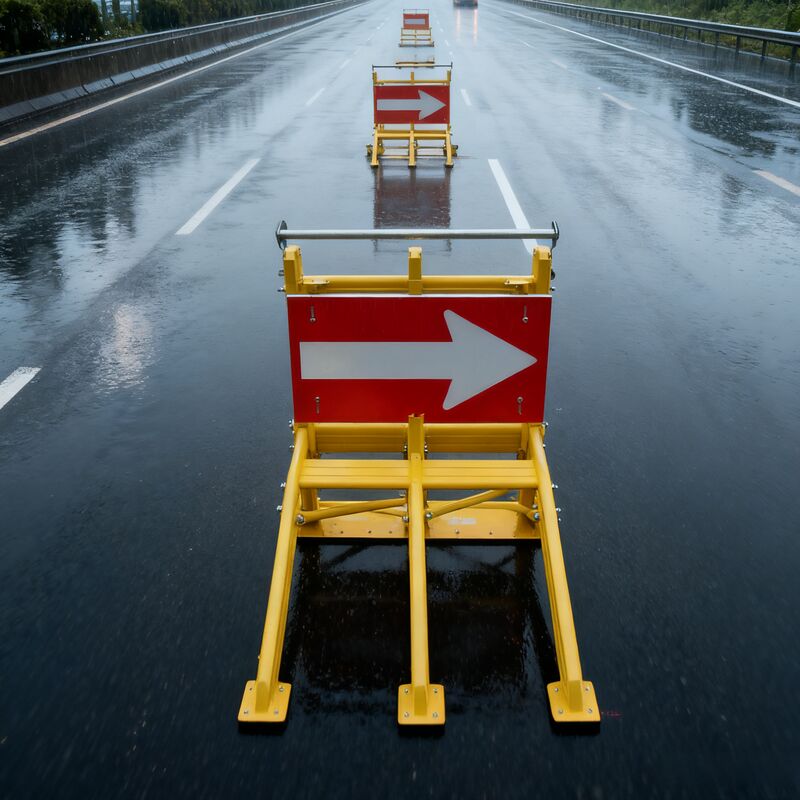
Rustproof 25KG Mobile Vehicle Barrier
The RMHs TOMARUKUN Small Vehicle Interception Device is a municipal road isolation and warning product specifically designed for low-speed traffic areas. Constructed from environmentally friendly aluminum and rubber materials through welding and bending processes, with an exterior finished in electrostatic coating, featuring a highly visible yellow/orange appearance.
The product has a compact structure, measuring W320mm × L1070mm × H860mm, weighs 25kg, and incorporates a foldable design with universal casters at the base, facilitating easy movement, deployment, transportation, and storage by a single person.

This device is primarily suitable for low-speed construction zones such as municipal road maintenance and repair sections. Its eye-catching appearance, combined with optional LED indicator panels, provides a strong visual warning. In the event of an impact, it is designed to stop a vehicle in a controlled manner, effectively protecting both drivers and construction personnel.
The non-flammable nature of the aluminum material also helps minimize secondary hazards. The product has passed testing by a Japanese automotive laboratory and can be deployed in flexible configurations according to specific road speed limits and scenarios, enabling modular deployment.
Product Specifications
| Material |
Aluminum alloy/rubber sheet |
| Color |
Traffic yellow/traffic orange |
| Function |
Intercept vehicle/shortening the impact distance |
| Surface treatment |
Electrostatic spraying |
| Thickness of the rubber |
10mm |
| Weight |
25KG |
Core Advantage Comparison
| Comparison Aspect |
Traditional Concrete/Iron Barriers |
Fixed Steel Interceptors |
RMHs TOMARUKUN Aluminum Interception Device |
| Deployment & Mobility |
Heavy and cumbersome, requiring multiple people to move; very low deployment efficiency |
Heavy weight, fixed position, cannot be quickly adjusted on-site |
Lightweight & Flexible: Only 25kg, equipped with universal wheels. Can be easily moved and quickly deployed by a single person. |
| Transport & Storage |
Occupies significant space, high transportation costs, inconvenient to store |
Bulky, difficult to store and transport |
Foldable Design: Significantly reduces space occupied, resulting in very low transportation and storage costs. |
| Safety & Protection |
Rigid collision can cause serious secondary damage to vehicles and personnel |
Strong protection but no cushioning, may cause severe vehicle damage |
Controlled Interception: Absorbs energy through deformation, stops the vehicle in a controlled manner by deceleration, reducing secondary harm |
| Durability & Maintenance |
Prone to weathering (concrete) or rust (iron), requiring frequent maintenance |
Requires anti-corrosion treatment; prone to rust with prolonged outdoor use |
Anti-corrosion Process: Exterior electrostatic coating is rust-resistant and suitable for long-term outdoor use, with simple maintenance |
| Additional Features & Warning |
Warning effect relies on external stickers; poor nighttime visibility |
Usually a single color with limited warning functionality |
High-Visibility Warning: Conspicuous traffic yellow/orange color, can be seamlessly paired with LED indicator boards for excellent day and night warning效果 |
| Eco-friendliness & Compliance |
Concrete is non-recyclable; iron has low recycling value |
Materials are recyclable but have high production energy consumption |
Eco-friendly & Recyclable: Made from eco-friendly aluminum, 100% recyclable, aligning with modern eco-conscious construction practices |
Core Summary: The RMHs TOMARUKUN device achieves an excellent balance between safety, mobility, cost-effectiveness, and environmental sustainability. It is not the "strongest" but the "smartest" solution—its lightweight, modular design maximizes deployment efficiency and minimizes total cost of ownership while providing controlled protection that meets modern safety standards.
Rubber plates are installed on the bottom support surface to increase the friction between the rubber and the ground. It is also equipped with two wheels for easy operation and movement.
Stopping Principle (How it Stops a Vehicle)
The device does not rely on its own rigidity to "block" a vehicle. Instead, it safely brings a vehicle to a stop through a controlled energy dissipation process.
- Impact & Deformation: When a vehicle impacts the device at low speed, its aluminum main structure undergoes controlled plastic bending and deformation
- Energy Absorption: This deformation process absorbs and dissipates the vehicle's kinetic energy from the impact, acting like a "controlled buffer"
- Deceleration & Stop: As the kinetic energy is absorbed, the vehicle's speed decreases rapidly, eventually coming to a smooth stop within a short distance, preventing secondary accidents like rollovers or severe damage
Core Concept: It "dissipates" the vehicle's impact force in a controlled manner by sacrificing its own structure, protecting occupants inside the vehicle and the safety of the work zone.
Setup Method (How to Deploy)
The setup is flexibly adjusted based on road speed limits. The core goal is to provide advanced warning and gradual deceleration.
Urban/Low-Speed Roads (Speed Limit ≤ 60 km/h)
- Location: Approximately 10 meters in front of the work zone
- Quantity: At least 2 units as a set, placed side-by-side
- Optional: Used with warning signs or LED arrow boards
Purpose: To provide a final, clear, and conspicuous physical warning and buffer barrier at close range.
Schematic: [Traffic Direction] → [Interceptors x2] --10m→ [Work Zone]
Highways/National Roads (Higher Vehicle Speeds)
- Location: Begin placing units 50-100 meters behind the work zone
- Method: At least 3 units as a set, arranged in a line along the traffic direction, with about 10 meters spacing between each
- Function: Forms a progressive warning and buffer zone
Purpose: To alert drivers to slow down from a distance through multiple layers of defense and provide staged cushioning for accidental intrusion.
Schematic: [Work Zone] ← [Unit 1] --10m-- [Unit 2] --10m-- [Unit 3] ← [Oncoming Traffic]
General Principles
- The quantity can be increased based on specific conditions, especially for longer work zones
- Must be used in conjunction with standard road work warning signs (e.g., cones, signs) to form a complete warning system
- The devices themselves must be conspicuous, ensuring their reflective color or LED lights are visible at night and in poor weather conditions
Setup and Usage Diagram
Frequently Asked Questions
Q1: What are the key features of this product?
A: Lightweight (25KG), mobile, durable, rust-proof, and quick to deploy. A single person can easily move and set it up, making it ideal for temporary operations at frequently changing locations.
Q2: How is its rust-proof performance ensured?
A: The main body is made of high-quality aluminum and treated with an external electrostatic spraying process, effectively resisting outdoor sun and rain, ensuring long-term use without rust, and high durability.
Q3: How is the product set up and used in practice?
A: Highly flexible in use:
- Low-speed areas (e.g., urban areas): Place at least 2 units side by side approximately 10 meters in front of the construction site as a final warning and buffer
- High-speed sections (e.g., national roads): Start placing at least 3 units 50-100 meters behind the construction site, arranged longitudinally with 10-meter intervals to form a progressive buffer zone
The product features universal wheels at the bottom and is foldable, making it easy to transport and store.
Q4: What is its safety principle? Is it a rigid barrier?
A: It is not a rigid barrier. It operates on a controlled energy absorption principle. When a vehicle collides with it, the aluminum structure absorbs the impact energy through controlled bending and deformation, allowing the vehicle to decelerate and stop smoothly, reducing secondary damage to the vehicle and personnel.
Q5: What scenarios is it suitable for?
A: Primarily suitable for construction areas with low-speed vehicle traffic, such as municipal road maintenance, temporary road closures, event isolation, etc. It is an essential facility for enhancing on-site safety levels.


 Your message must be between 20-3,000 characters!